
BY STAFF WRITERS
Curtis Woodward’s FootyTown app is out, about and in full-swing, with almost 1500 locations and available on the App Store and Google Play.
While we’re always adding new locations on a daily basis – it is after all – Grand Final Week!

The Sydney Roosters are gunning for another premiership against Newcastle but the club and its famous identities date back to the beginning of the sport in Australia in 1908.

Here’s fifteen Roosters-related locations on the app…
JACK GIBSON
“In a peculiar event, a group of Easts players that included budding front-rower star Jack Gibson left the club during the [1954] season and went bush to play for Grenfell. Gibson and a couple of others had connections with a famous but illegal Sydney institution, Thommo’s Two-Up School, and quietly left town when the temperature around Thommo’s became rather too warm due to increased pressure from the authorities” – ‘A Centenary of Rugby League’.
For the record, Gibson’s last match in ’54 was a round nine match, on June 6, against Newtown at Henson Park.
According to Rugby League Project, just one other first grade player from Easts played their last game of the season that day, Gibson’s fellow prop Allan Wilson.
ANGLICAN PRESS
Here comes another Jack Gibson story which includes a young Rupert Murdoch and a young Kerry Packer. In 1960, a turf war between Murdoch and the Packers was unleashed on Sydney’s streets with Clyde Packer, Kerry and “muscle men” breaking into the offices of Anglican Press and assaulting staff. A few years earlier, Rupert Murdoch had attended Thommos 2 Up and befriended Jack Gibson. After several phone calls, workers at the illegal gambling dens were sent to Queen Street in Chippendale on behalf of Murdoch – including Gibson. While Gibson and Kerry would become mates years later, Tom Prior wrote in his 1993 book ‘The Sinner’s Club’, that Kerry “really copped a thumping”. Rupert himself was receiving “blow-by-blow” updates on the phone from former Mirror editor Ian Smith.

GLEBE POLICE STATION
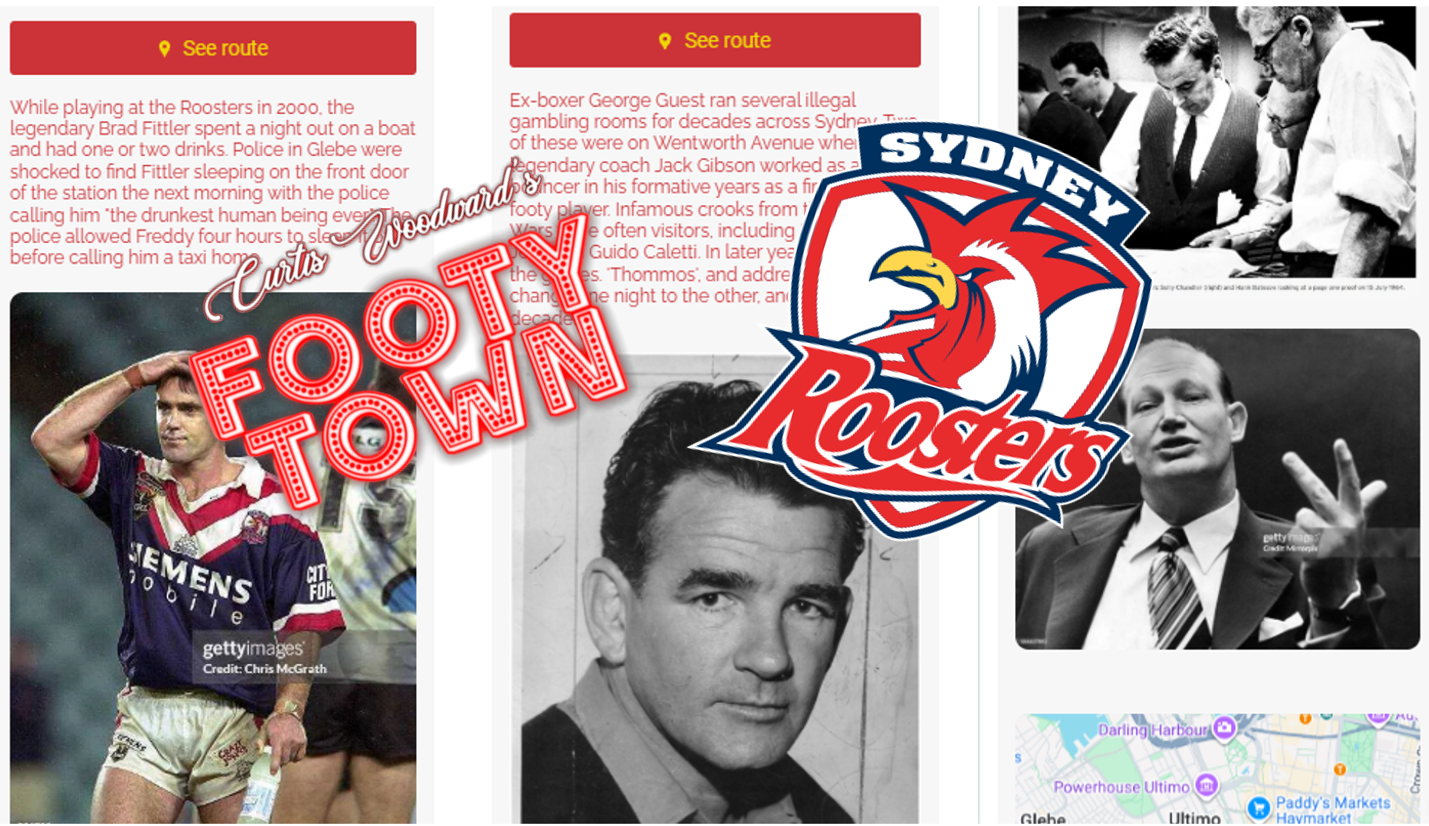
While playing at the Roosters in 2000, the legendary Brad Fittler spent a night out on a boat and had one or two drinks. Police in Glebe were shocked to find Fittler sleeping on the front door of the station the next morning with the police calling him “the drunkest human being ever”. The police allowed Freddy four hours to sleep it off before calling him a taxi home.

THOMMO’S TWO-UP SCHOOL
Ex-boxer George Guest ran several illegal gambling rooms for decades across Sydney. Two of these were on Wentworth Avenue where legendary coach Jack Gibson worked as a bouncer in his formative years as a first grade footy player. Infamous crooks from the Razor Wars were often visitors, including Phil ‘The Jew’ Jeffs and Guido Caletti. In later years, Gibson ran the games. ‘Thommos’, and address, could change one night to the other, and went on for decades.

JACK GIBSON & ARTHUR BEETSON
At the end of 1984, great mates Arthur Beetson and Jack Gibson were back in the big league and set to coach respective clubs, Eastern Suburbs and Cronulla-Sutherland for the 1985 season. While playing golf together at The Lakes, as told to Andrew Webster in Jack’s book ‘Supercoach’, Gibson offered ‘Artie’ a handshake and made a pact that they wouldn’t steal each others players.
Balmain’s cult hero Olsen Filipaina had shook Gibson’s hand and agreed to join the Sharks in ’85. At the last second, Olsen rang Jack and told him he had signed with Easts for more money.
It was the first of two rifts between Jack and Arthur.
Beetson refuted of any such agreement with his friend.
“It was Arthur’s decision and as far I’m concerned we’re finished,” Jack told The Mirror.
The pair would make up but had another bust-up when Beetson used some of Jack’s coaching manuals “without permission.”

INGHAMS HOUSE
Family home of Bob Ingham from the Inghams poultry dynasty – established by Walter Ingham in 1918. His sons, Jack and Bob [who would become billionaires] were big gamblers and became close friends with Jack Gibson who doubled as an SP bookie in his playing days. The Ingham money supporting the club in the 1960s led to the ‘rooster’ becoming an “unofficial” Easts mascot to begin with.
MEEKS STREET
Street of the family home of Roosters great Jack Coote where his son Ron grew up. Ron Coote was destined to become an Eastern Suburbs champion, like his father. When the league re-zoned the districts, Easts lost Randwick, Coogee and Maroubra to arch rivals, the Rabbitohs [many Roosters supporters still live in these areas and still consider it Roosters territory]. ”And that’s how I ended up playing for Souths instead of Easts, where my father had played,” Coote told The Sydney Morning Herald in 2013. ”If they didn’t move the area three streets over, I would have been a Rooster probably my whole career.”
After becoming a legend of the Souths club, Coote [as Australian skipper] rightfully expected an upgrade of his contract with the Rabbitohs after Dennis Tutty’s win in court. The Rabbitohs refused to give Coote an extra cent. Coote explained that at the time, Easts coach Don Furner would sit out the front of the Coote home until he got home from work most days and discuss switching to Easts. It happened. Coote would then become a legend of the Roosters and eventually become an Immortal in 2024.

2002 ROOSTERS
The Sydney Roosters had a horror start to the 2002 season, losing four-straight games between round two and round five. Ahead of their round six match, players turned up to training expecting a gruelling hit out to prepare for their clash against the Cowboys. Instead, new coach Ricky Stuart told players they were catching a ferry to The Steyne Hotel for dinner and beers. It broke the shackles. The Tricolours won their next five and finished the season in fourth place. Stuart’s Roosters then defeated Cronulla, Newcastle, Brisbane and then Warriors in the grand final to win their first premiership since 1975.
BEETSON SACKS VAUTIN
Queensland skipper Paul Vautin’s Maroons had just gone down 8-0 in Game I of the 1990 series at the SFS. By then, Vautin was playing at the Roosters and walked into Easts Leagues Club where he was confronted by journalist Ray Chesterton. According to Vautin in his Fox League documentary, Chesterton told him he had been dropped by the Maroons and coach Arthur Beetson. It was Vautin’s 22nd and final game for QLD and ‘Fatty’ had not heard from Beetson who was also still involved with the Roosters club at the time.
EASTS HOUSE
While Anzac Parade is long considered the boundary line between arch enemies, Souths and the Roosters, the line may actually be Alison Road.
“One such location is Easts House on the corner of Alison and Avoca streets. Originally built as the Randwick Post Office in 1897-98 on land owned by St Jude’s Church of England, the building was purchased by Eastern Suburbs Leagues Club in 2000 and became the administration centre for the Ted Noffs Foundation. It seems somehow appropriate that such a significant Roosters building sits right on the edge of the club’s traditional territory” – James Smith’s rugbyleaguestreet.substack.com
BONDI BEACH
Hanging above legendary Roosters boss Nick Politis’ office desk are several famous photos including one of Prince Charles in 1977 going for a surf at Bondi with Uncle Nick’s ‘City Ford’ splashed across the surfboard.

JACK ‘BLUEY’ WATKINS
Now known as Crown Street Public School, the location where Jack ‘Bluey’ Watkins attended then-named Surry Hills South Public. The legendary lock is considered the original long-range cover defender.
“Considered by many to be have been a shock omission from the list of the 100 greatest players of the first century of Australian rugby league, Jack ‘Bluey’ Watkins is undoubtedly one of the Roosters’ greatest ever forwards. Watkins is the only player from any club to have won a premiership and played for Australia before World War I and again after World War I,” from roosters.com.au.
“An Easts junior from the Barcom West club, Watkins starred as a 20-year-old in the 1913 Easts premiership team and played for Australia at just 21 in 1914. However, he would later miss nearly three years of rugby league when he signed up for service in World War I (rising to the rank of Sergeant in the AIF), but not before playing in three successive City Cup winning teams, including captaining the 1916 team. On his return to the game Watkins was back in the Australian team within two months and was later to be one of the Australian stars on the 1921/22 Kangaroo tour. The Sporting Chronicle described Watkins as “the best loose forward we have ever seen”.
“Defensively he was a colossus and rated one of the greatest defenders of the pre-World War II era. Watkins was the forward leader when Easts won the 1923 title, despite carrying a number of injuries. Watkins was as comfortable playing as a second row forward and a prop forward as he was in his favoured position of lock forward and played in all three positions for his club and country. After a season in Tumut in 1925, Watkins took on the captain/coach role at Easts in 1926, where they finished third, in his final season.”
EDDIE GRIFFITHS
Head office of NSW Fire & Rescue.
From fire.nsw.gov.au:
“It is also fitting to recognise that a former Roosters champion was the Chief Officer [Commissioner] of the NSW Fire Brigades and a Gallipoli veteran.
“Eddie Griffiths won three premierships with Eastern Suburbs in 1911, 1912 and 1913, playing alongside the brilliant ‘Dally’ Messenger, and was appointed NSWFB Chief Officer in 1948.
“He was described by one of his early commanders as “Our greatest firefighter…a legend in the true sense of the word.”
“A 40-year firefighter, Mr Griffiths served as an artilleryman in Egypt and Türkeye during World War I.”
‘Big Jack’: The top ten locations featuring the legendary Jack Gibson on the FootyTown app
FRANK HARON
‘Haron was the overseer of the Royal Agricultural Showgrounds when League commenced and an intense supporter of allowing Easts to play out of the RAS in the early days when many other venues at this time were blocked. Was Roosters President from 1917 to 1944. In 2020, Nick Politis took over from Haron as the club’s longest serving chairman. First Easts life member [1926]. Haron had sight in just one eye’ – Easts historian Alan Katzmann.
ARNOLD SCHWARZENEGGER
Bodybuilder Arnold Schwarzenegger, who would go on to become one of the biggest Hollywood movie stars of all time, attending Roosters training in 1974 at Moore Park. A photographer asked Arnold to lift Arthur Beetson into the air. Arnie replied, “I’m a bodybuilder… not a power lifter”. According to thearnoldcollection.com, Arnold is wearing Ron Coote’s shoes in the attached photo as it was a cold night in Sydney.

