BY STAFF WRITERS
The FootyTown app is available right now on Google Play and features over 700+ locations and counting.
Enjoy ten locations from the app below including blurbs from the app.
Download and find them.

LEN SMITH
One of the biggest rugby league scandals of the 1940s was when imcumbent Australian captain/coach Len Smith missed selection for the 1948 Kangaroo tour despite also just being named the premiership’s player of the year and leading Australia to a series win over New Zealand. The SCG game day programme was full of praise for the new skipper who was now a Dual International and a war hero: “Playing his first Rugby League match for Australia to-day Len Smith has the double honor of captaining the home side,” the preview began.
“He is the bulwark of the Australian defence and the spearhead of attack, a strong running centre three quarter whose soundness in every phase of the game makes him such a desirable type to lead in an international match.”
Smith’s name was then not read out for the touring party.

Rumour has it Smith was ousted because he was a Catholic. The selectors were Masons. He retired from the game immediately and never played again.
From Steve Ricketts on his own website: “The selection of the 1948-49 Kangaroos provided what was probably the greatest shock in the history of the code, with Col Maxwell named as tour skipper. Len Smith, captain-coach of the Test side which beat New Zealand on the day the touring side was named, was not among the 28. His omission caused a public outcry, and there seems little doubt he was overlooked because he was a Catholic, a reflection of the times.”

Amazingly, when Maxwell was named as the new Australian captain for the tour, Wests had dropped him to reserve grade but never told him and reinstated him back into the first grade side after hearing he was on the way to England.
Just like Len Smith, who retired, Maxwell also never played for Australia again.

In retirement, Smith wrote for the Sporting Life magazine and created The Magic Mile which runs annually at Menangle Racecourse [since 2008].
ROBERT TRIMBOLE
One of the biggest mafia drug barons in the history of the state of NSW. Trimbole is still the main suspect in the disappearance of politician Donald Mackay. Trimbole fled Australia and eventually died in Spain. He is buried at Pine Grove in Minchinbury. Trimbole’s link to footy is via former St George and Souths prop Harry Eden who worked as an SP bookie in his later years and held bets for Trimbole himself – upwards of $50,000 cash at a time.
BOURBON & BEEFSTEAK
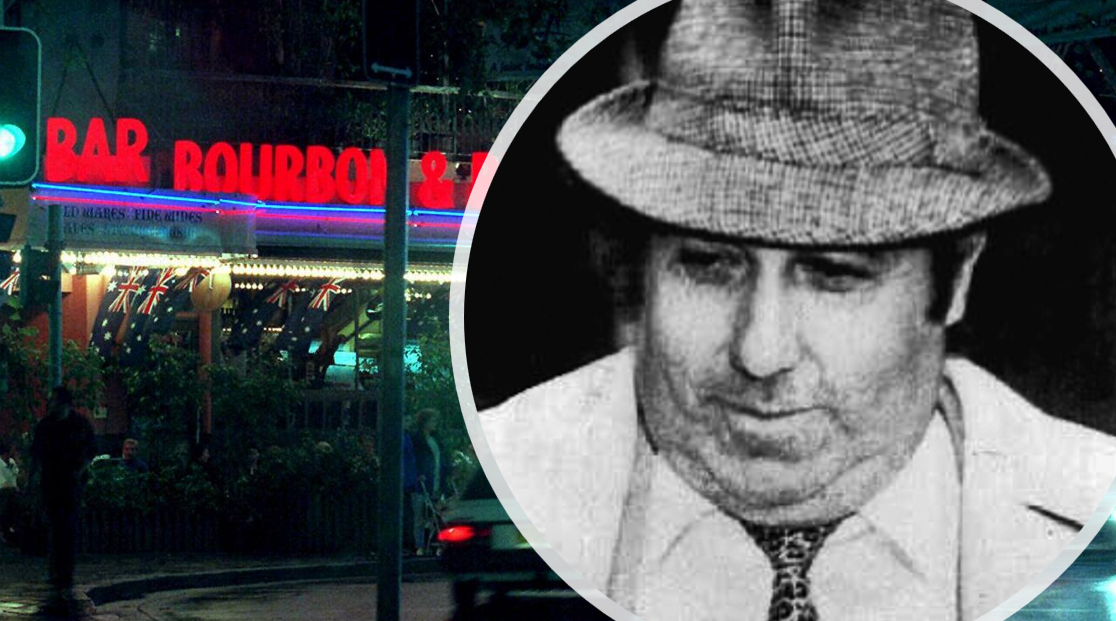
Infamous pub in Kings Cross where celebrities, footy players, criminals and many others rubbed shoulders. Johnny Raper loved a drink anywhere but would frequent this place after most big games, including grand finals. Story goes, Manly wizard Cliffy Lyons spent every Sunday evening here after big games and loved a punt on the pokies. Also where a young, drunken cricketer named Ricky Ponting was knocked out with one punch in 1999 after spilling a drink on bouncer, and former footy player Mani Solomona.
After Balmain’s traumatic 1989 grand final loss, Tigers players headed to the ‘Bourbon’.
Story goes that Garry Jack’s wife kept calling the bar asking him to come home. Eventually Jack went and made the call. A furious Steve ‘Blocker’ Roach got up, grabbed the phone and pulled the line right out of the wall.
MCQUILLAN’S GYM
Built in the 1800s, the former Oddfellows Hall was used as the meeting place of the old The Ancient Order of Druids from 1903. Decades later it was sold to boxing trainer Ernie McQuillan. Anthony Mundine and Solomon Haumono became best friends early in their lives and spent many hours at the gym as McQuillan trained their championship-winning fathers. A fire ended McQuillan’s time at the gym in the 1960s and is now a split, residential property.
“LEFT ALONE TO DIE”
On March 31st, 1908, NSW Rugby Union held their annual meeting at their old building. Rugby league was beginning their first season but there seemed to be no worries from rugby union. Things changed drastically in 1909 when the touring Wallabies returned to Australia and many players jumped ship to the new Australian sport.
From The Sydney Morning Herald at the time…

“The New South Wales Rugby Union held its annual meeting at the rooms last evening. The president [Mr. J.J Calvert] occupied the chair. In proposing the adoption of the annual report, Mr. Calvert said that the professional element could be left alone to die. In spite of their efforts to induce amateurs to join their ranks, only one member had gone over to professionalism. [Hear, hear]. There was no support in the country for the new idea.”
Some may forget that the Kangaroos and Wallabies toured the United Kingdom at the same time with the NSWRL challenging them to a match while both sides were in London. The rugby union declined. When the sides returned to Sydney, 14 Wallabies players agreed to a blockbuster match in 1909. Those players were banned by rugby union and signed with fledgling NSWRL clubs.
THE DREADNOUGHT FUND
A request from the NSW Government back to Britain regarding a ship would lead to the earliest scandal between the rugby codes in the country. Rarely spoken about, it was regarded as a bombshell and gutted Australian rugby union. In 1909, Sydney Lord Mayor Allen Taylor announced the Dreadnought Fund to raise funds to purchase a battleship from the British Navy. During this period, both the Kangaroos and Wallabies were touring England. Little did anyone know, ‘Jersey’ Flegg’s brother William had been secretly approaching Wallabies players about switching to the NSWRL when they returned to Australia. The Dreadnought Fund seemed a perfect opportunity for the NSWRL to pounce.

The letter below was sent to Town Hall:
“My Lord, – as nearly all sections of the community are now co-operating to swell the funds for your Dreadnought scheme, may I suggest that the different bodies controlling Rugby football should unite in showing their patriotism and at least for once “bury the hatchet”, by agreeing to give a combined football display during the season. To give effect to my suggestion, I propose that Rugby League (Kangaroos) should play a friendly game with the Rugby Union (the Wallabies), the entire proceeds to be devoted to your proposed Dreadnought funds. Arrangements may also be made to obtain the grounds free of charge, and for that benefit we are prepared to give the Agricultural Grounds free of charge. I understand that there is absolutely nothing in the rules governing either body to prevent such a match taking place, and if necessary I beleive our body is prepared to play under the odl Rugby Union rules. I am prepared to arrange a conference between the League and the Union body if the latter is willing to meet us. I am aware that Rugby Union has already arranged a benefit match to take place on Wednesday, but I venture to predict that the proceeds from this Wednesday’s match would be insignificant compared to the handsome donation the funds would receive if my suggestion is carried out. There is not a ground in Sydney sufficiently large enough to hold one-half of the crowd that would turn up at this match. Kindly place this matter before the Rugby Union officials and their reply – Mr E.W.O’Sullivan (President of the N.S.W. Rugby Football League)”
Fourteen Wallabies played in the three-match “exhibition” series and were immediately banned from the rugby union and joined NSWRL clubs. The Kangaroos won the first match 23-20 before the Wallabies won the last two by 34 to 21 and 15-6. The showdown between Messenger and McKivat stole the show.
In Peter Sharpham’s ‘The First Wallabies and the Defection to Rugby League’, it is revealed that Bill Flegg had written to the NSWRL about recognition for his work and a season’s membership. The NSWRL replied about possible life membership in the future but stayed clear of offering Flegg anything else in return.
Flegg then went to the papers with The Sun publishing an article titled, ‘The Wallabies’ Price, Startling Statements by a League Promoter’ with direct quotes from Flegg: “And now the bombshell. I am going to give to the public of Australia for the first time the secret amounts the Wallabies received in playing in the matches against the Kangaroos. I know that the publication of these large sums will cause considerable consternation in certain quarters, but it cannot be helped. I now give the amounts to the public. Here they are:
McKivat [Glebe] £200
McCabe [Souths] £150
McCue [Newtown] £150
Barnett [Newtown] £100
P. Burge [Souths] £100
McMurtie [Orange] £100
McIntyre [Orange] £100
Gavin [Orange] £100
Dix [Armidale] £100
Mandible [Sydney] £100
Hickey [Glebe] £100
Russell [Newtown] £100

“The amounts disbursed to the Wallabies [including Farnsworth] totalled £1850, and the gates £121 short of this so the League was called upon to make up the shortage. The Wallabies grabbed everything and the Kangaroos were left lamenting without a single copper. I never received a penny although I was responsible for the matches; and it is a fact even Messenger did not receive anything. This season the League tendered the Kangaroos a benefit match against the Englishmen, each player receiving £15.
OUTLAW SUNDAY COMPETITION
The NSWRL were very much anti-Sunday and scheduled the majority of their games on Saturdays as Sundays were considered a day of rest and to frequent church. Occassional games were played on Sundays if venues were pre-booked or for other reasons. This left a market in the 1940s and 1950s for colourful footy characters, bookmakers, race types and punters to get behind an unsanctioned outlaw Sunday rugby league competition played at various Eastern Suburbs and Inner-West venues like Rushcutters Park and Waverley Oval. The teams were fairly strong and made up of lower grade players, some former internationals and rugby union stars playing under pseudonyms to save their ‘amateur status’. Teams included La Perouse All Blacks, The Wharfies, Celebrity Club, Bing and Swing and Bondi Lifesavers.
BBQ KING
Iconic Sydney restaurant of 40 years where in 1994 South Sydney’s John Elias was offered a massive bribe by a former prison mate from Long Bay Jail to ‘fix’ the upcoming Rabbitohs vs Magpies match at Campbelltown. BBQ King moved down the road in 2016 before closing its doors.
“For months and years later the big question would always be: who were the players [that were in on the fix]? No-one said a word but the media reported Craig Field, Darrell Trindall, Tyrone Smith and Jacin Sinclair. They and I were the obvious ones because we were the knockabouts in the side. The four of them later sued for defamation and won. The media outlet that made the accusation – Channel 7 – had no proof they were involved in anything suspicious.
“So who were the players? I will not say.”
From John Elias’ book, ‘Sin Bin’…
Newspapers on the Sunday morning of the game, reported a fix was in but didn’t mention player’s names. When the Souths bus showed up at Orana Park, camera crews and journalists were waiting. In ‘Sin Bin’, Elias confirms that his four teammates pulled out of the sting but several heavy hitters had put even more money on Wests to win at $2.60. According to Elias, Souths players were happy to be part of the fix, planning to win the game by a small amount of points.
A year later, Elias was sent to prison for supplying amphetamines and possessing prohibited items.
LYCEUM THEATRE
A famous Sydney theatre since demolished where Canadian film maker and producer Cosens Spencer made his name on Australian shores. Then came eccentric and the genius, Hugh McIntosh, who after falling over several other ventures, turned to boxing promotion. McIntosh had hurriedly built Sydney Stadium as an open boxing stadium in Rushcutters Bay and made good money on the 1908 Heavyweight Boxing bout between Jack Johnson and Tommy Burns. Cosens Spencer filmed the fight and promoted it world-wide. McIntosh was a big footy fan and supported the NSWRL. The McIntosh Shield was one of the first trophies presented to a rugby league club in Australia. Balmain received it three years in a row between 1915-1917.
OLYMPIC HANDBALL
After securing the 2000 Olympics and in an attempt to raise the profile of the European-dominated sport of handball in Australia, local organisers alongside Channel 7 and the Australian Handball Federation hatched a plan for a reality TV show which would see high-profile athletes from other sports learning the game and eventually representing Australia at the games in Sydney. This included former Cronulla star and Test International, Mark McGaw. The TV show didn’t happen and McGaw never became a Dual International.
“They’d been training all their lives and someone was going to get picked to jump on the Olympic bandwagon and not have to do all the work they’d done,” McGaw told The Sydney Morning Herald’s Vince Rugari in 2020. “They were, as my son calls it, butthurt. I sat in on the meeting, because I was one of the ones who looked like was going to go, and they just had these issues.”
Part One: Ten amazing locations from Curtis Woodward’s FootyTown app available now on Google Play